.svg)
.svg)
Back to Blog List
Why Most B2B Ads Look the Same (and Why Meta's Algorithm Now Punishes It)
Meta's Andromeda update handed targeting to a machine that reads your creative to decide who sees it. Why bland B2B ads now get buried, and how to fix it.

Joe Harulow
Founder of Sprint Creative, a B2B paid ads agency.

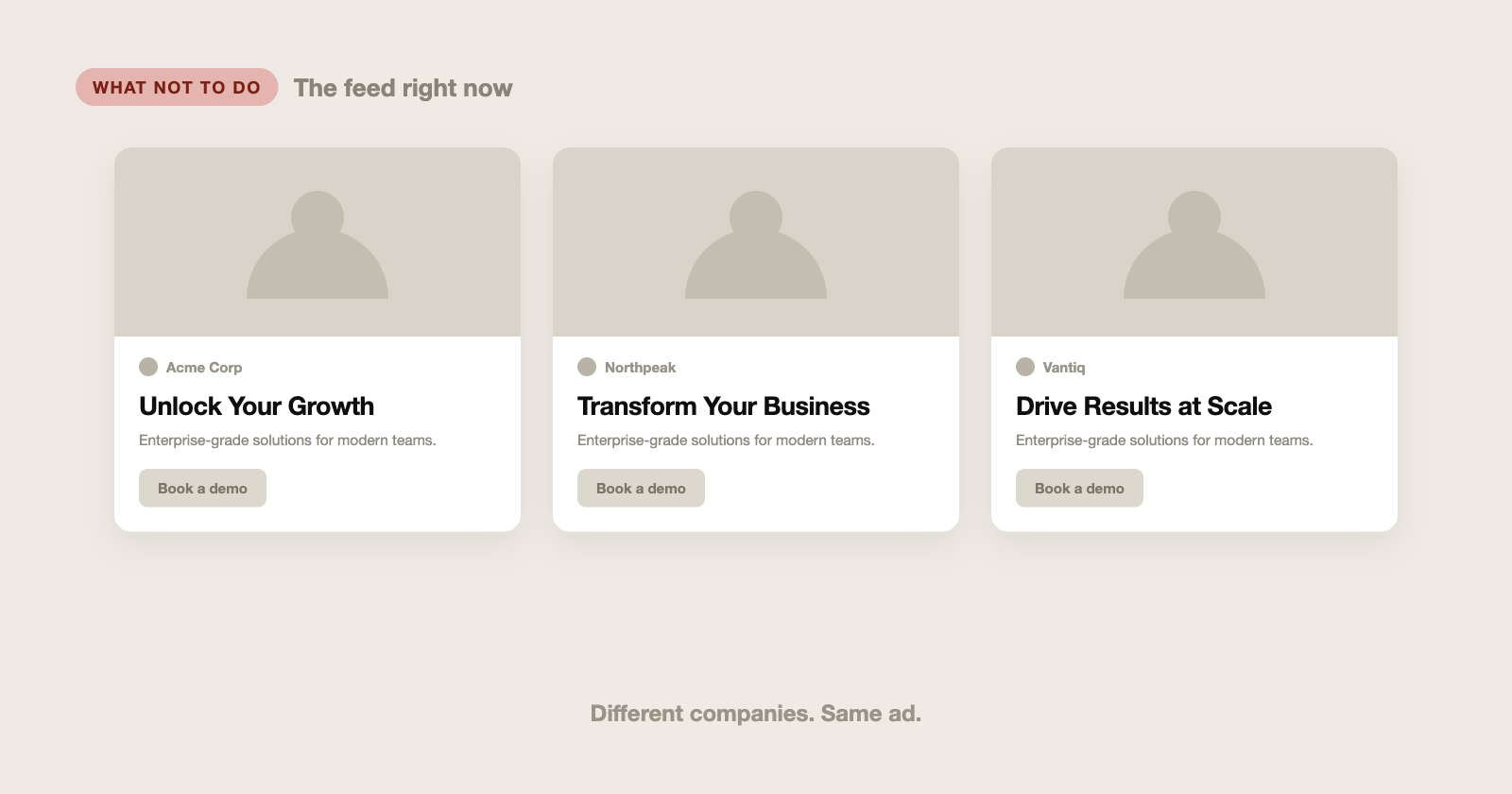
Scroll through LinkedIn or Meta for two minutes and you'll notice something. Nearly every B2B ad looks identical. A stock photo of people shaking hands or staring at a laptop. A headline about “unlocking growth.” A logo in the corner. A “Book a demo” button. Different companies, same ad.
That sameness has always been lazy. In 2026 it became something worse. It got expensive. Meta quietly rebuilt the engine that decides who sees your ads, and that engine has no patience for creative that blends in. If your ads look like everyone else's, the algorithm now has every reason to bury them.
The short version
• The machine took over targeting. Meta's Andromeda update means your creative, not your audience settings, now decides who sees your ads.
• Bland gets buried. Generic ads give the algorithm nothing to work with, so they quietly lose delivery. Distinctive ones win it.
• Feed it variety and personality. Give each campaign 10 to 15 different concepts, make some look organic, and don't be scared to be funny. Your buyer is human.
Now here's the full story: what changed, why it matters, and how to build B2B creative that actually works in the feed you're paying for.
Why B2B ads all blend together
Three forces push B2B creative toward the mushy middle:
• Fear of looking unprofessional. B2B brands think “serious” has to mean “safe,” so they sand off anything distinctive.
• Templates and stock libraries. When everyone pulls from the same asset packs, everyone ends up with the same visual.
• Designing for the sign-off meeting, not the scroll. Ads get built to survive internal approval, not to stop a stranger mid-feed.
The result is a feed full of ads that are inoffensive, on-brand, and completely ignored.
What actually changed: Meta stopped letting you pick the audience
For a decade, paid social ran on a simple deal. You picked the audience (job titles, interests, lookalikes) and Meta served your ad to them. Targeting was the skill. Creative was the thing you made once the “real” work was done.
That deal is over. Over the last couple of years Meta has quietly pulled manual targeting apart. Detailed targeting exclusions? Gone in 2025. Hundreds of niche interest categories? Merged into broad buckets. Advantage+ became the default, and the audiences you set by hand are now treated as suggestions rather than rules. Meta's own interface keeps nudging you toward “broad,” over and over.
This isn't Meta getting lazy. It's Meta getting confident, because the machine now does the targeting better than you can.
Meet Andromeda: the engine behind the shift
In October 2025 Meta rolled out Andromeda globally. It's a new AI retrieval engine that sits right at the front of the ads system, built on NVIDIA's Grace Hopper superchips and Meta's own silicon. It has one job: the first pass of deciding which ads you're even eligible to see.
Every time an ad slot loads, Meta has tens of millions of possible ads it could show you. Andromeda sifts that down to a few thousand genuinely relevant ones in milliseconds, using thousands of behavioural signals about who you are. Meta says it delivered a 10,000x jump in model capacity, with real gains in ad quality and relevance.
In plain English: Meta has gotten dramatically, almost unfairly good at working out what a specific human actually cares about, then matching an ad to it. The system isn't audience-first any more. It's creative-first.
You no longer choose who sees your ad. Your creative does.
Why this makes creative your real media buying
Here's the bit most B2B advertisers haven't caught up to yet. If the algorithm decides who gets your ad based on the creative itself, then your creative isn't decoration on top of the campaign. It is the campaign.
Andromeda reads your ad (the visual, the hook, the format, the feeling) and uses it to find the pocket of people most likely to respond. A dull, generic ad gives it almost nothing to go on, so it gets matched to nobody in particular and quietly starved of budget. A distinctive ad that clearly signals who it's for gives Andromeda a strong scent to follow.
That's why the advice from serious media buyers all lands on the same number. Give each Advantage+ campaign 10 to 15 genuinely different creatives. Not 10 colour swaps of the same ad. 10 different ideas, angles and formats. You're not writing one perfect ad any more. You're handing the algorithm a menu and letting it find the diners.
An AppsFlyer study in 2025 put a number on it. Somewhere between 70 and 80 percent of Meta ad performance now comes down to creative, not budget or targeting. The lever moved. Most B2B advertisers are still yanking on the old one.
The counter-intuitive part: your ads should look less like ads
If the feed is where you're competing, the ads that win are the ones that belong in the feed. Andromeda rewards engagement, and people don't engage with things that scream “sponsored corporate message.” They engage with content.
So the best B2B creative in 2026 often looks organic. A founder talking to camera on their phone. A screen recording. A screenshot of a genuinely funny Slack message. A meme only your buyer would get. A photo that looks like someone snapped it on the way into a meeting, not in a studio. It's not that “scrappy” is a trick. It's that native-looking content earns the one thing the algorithm can't hand you: real attention.
The mix is the point. A feed of nothing but glossy brand films reads as advertising and gets tuned out. A blend, some polished and plenty that looks like a person made it that morning, reads as a presence. Aim for a spread, not a single note.

B2B buyers are human. Advertise to the human.
Somewhere along the way, B2B decided its buyers stop being people between 9 and 5. They don't. The finance director you're chasing scrolls the same feed as everyone else, past the dog videos and the football banter and the memes, and then your ad about “end-to-end workflow optimisation” slides by without so much as a blink.
Humour is the most underused weapon in B2B. A joke that lands does three things at once. It stops the scroll. It shows you actually get the buyer's world. And it makes you memorable in a category where everyone else is beige. You don't need to be a comedian. You just need to be recognisably human: say the thing your buyer is actually thinking, name the frustration everyone pretends they don't have, and be a little bit brave.
Serious and credible aren't the same thing. Plenty of very serious companies run very forgettable ads. Being human isn't unprofessional. It's the whole game now that the machine rewards attention.
What actually stops the scroll
Whatever the algorithm is doing under the hood, the physics of the feed haven't changed. Great creative still has to pass three tests at once:
• Pattern interrupt. It looks different enough from the surrounding feed to break autopilot.
• Cognitive ease. The one idea lands in under a second, no decoding required.
• Emotional trigger. It taps a real feeling: relief, recognition, ambition, a laugh, a bit of outrage.
Miss one and the ad underperforms. Nail all three and you stop the thumb, which hands Andromeda exactly the engagement signal it's hunting for.
The non-negotiable: a visual hook
Typography alone won't cut it. Every strong ad needs a non-typographic visual hook, a central device that creates the pattern interrupt. A phone mockup showing the product mid-use. A loading bar. A desk calendar. A screenshot. Some unexpected object that makes the concept click instantly. The hook earns the half-second of attention that your copy then converts, and it's also the clearest signal the algorithm has about who this ad is for.
How to build B2B ads that work now
Put it all together and the 2026 playbook looks like this:
1. Go broad on targeting, deep on creative. Let Advantage+ find the audience and put your effort where it now counts.
2. Feed the machine variety. 10 to 15 genuinely different concepts per campaign, not colour swaps.
3. Make some of it look organic. Founder videos, screenshots, native posts. A mix beats a wall of polish.
4. Use humour and be human. Your buyer is a person scrolling for a break, so earn the smile.
5. One idea per ad. If you can't say it in a sentence, it's two ads.
6. Lead with a visual hook, not a headline. Design the interrupt first.
7. Ban the stock photo. If a competitor could run the same image, it's invisible.
8. Test concepts, not colours. Big swings in idea beat tiny tweaks in shade.
The takeaway
Most B2B ads look the same because sameness used to be safe. It isn't any more. Meta handed the targeting to a machine that reads your creative to decide who sees it, so bland ads don't just underperform. They get buried before anyone lays eyes on them. The brands that win from here are the ones feeding the algorithm a rich, varied, human, occasionally funny stream of ideas that actually look like they belong in the feed.
The good news? This is a creative problem, and creative problems are solvable. You don't need a bigger budget. You need braver, more human, more varied ads.
Want to see what this looks like in practice? Browse our case studies to see the creative behind the results, or book a strategy call and we'll pull your current ads apart together.


Lastest blog posts
Tool and strategies modern teams need to help their companies grow.

How Much Should a B2B Company Spend on Paid Ads? (UK Guide, 2026)
Forget generic benchmarks. Work backwards from the revenue you want, know your minimum viable test, and scale on one metric. The honest UK numbers for 2026.


B2B Ad Creative Services: What You're Actually Paying For (and What It Should Cost in 2026)
Most B2B companies buy "designs" when what they need is creative that converts. Here's what proper B2B ad creative services include, what they cost, and how to choose.


.svg)
The system that books qualified sales calls every week.