.svg)
.svg)
Back to Blog List
Meta Ads for B2B: The Complete Guide (2026)
Do Facebook and Instagram ads actually work for B2B? Yes, and usually cheaper than LinkedIn. The complete 2026 guide: strategy, creative, budgets and benchmarks.

Joe Harulow
Founder of Sprint Creative, a B2B paid ads agency.
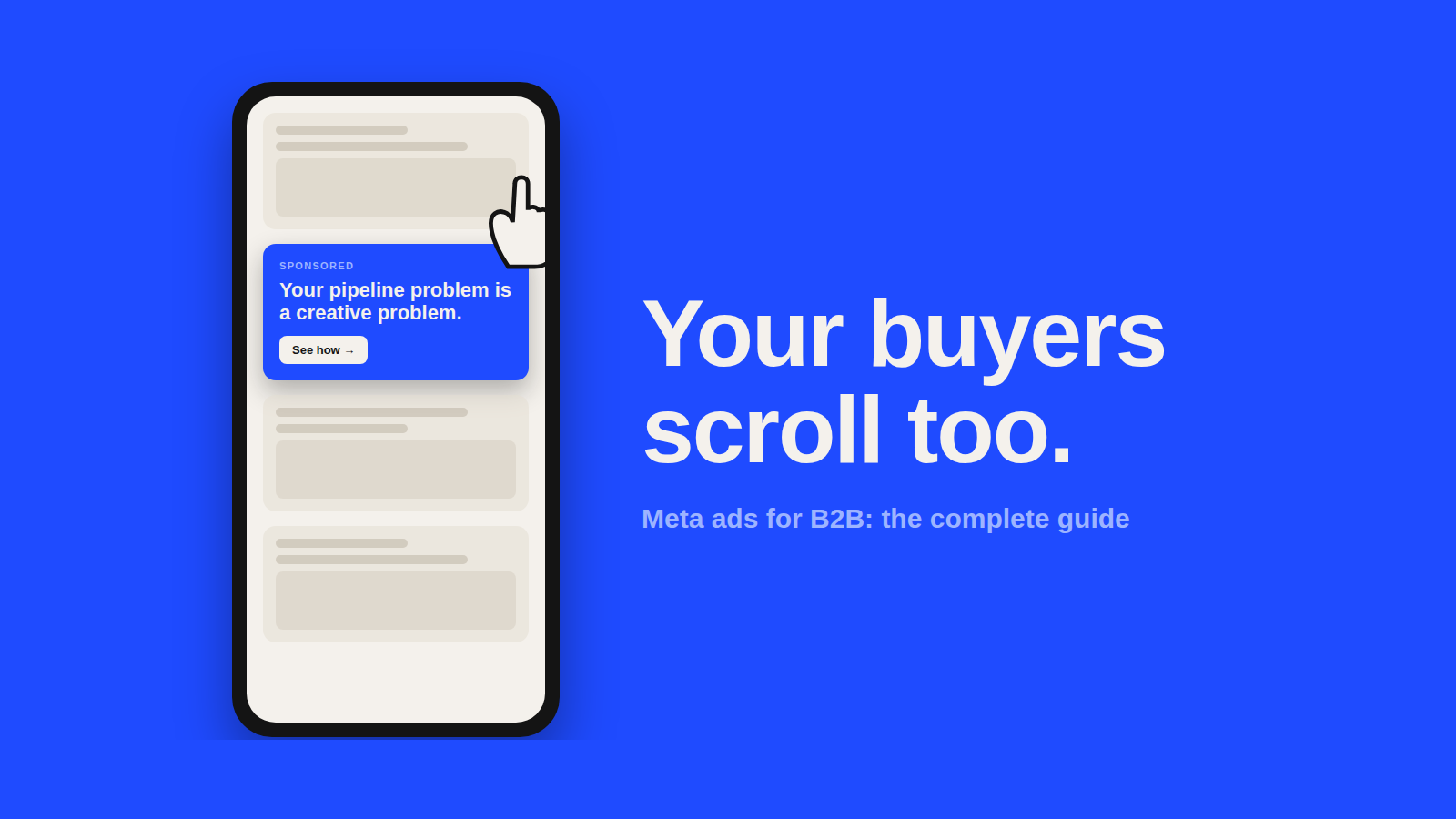
Meta ads work for B2B. Your buyers scroll Facebook and Instagram like everyone else, and reaching them there costs a fraction of LinkedIn. But B2B Meta only works under specific conditions: broad targeting with creative doing the qualifying, an offer matched to cold traffic, tracking that optimises to qualified calls instead of cheap leads, and enough budget to feed the learning phase.
The short version
• Your buyers are on Meta, and reaching them costs a third of LinkedIn's rates.
• Creative is now the targeting. The algorithm reads your ad to decide who sees it.
• Optimise to qualified calls, not cheap leads, and judge on CRM truth, not platform claims.
• Budget for a 90-day arc: roughly £1,000–1,500/month minimum, scaled on cost per qualified call.
Does Meta actually work for B2B?
The objection comes up on almost every sales call: "our buyers aren't on Facebook."
They are. The founder you're trying to reach watches Instagram Reels at 9pm like everyone else. The operations director scrolls Facebook while the kettle boils. B2B decision-makers don't stop being people when they leave the office, and Meta's reach in the UK is functionally everyone.
The real questions are whether you can reach them efficiently, and whether they'll act. On the first: B2B-relevant CPMs on Meta typically run £8 to £15 in the UK. LinkedIn regularly charges £30 to £60 for the same person. That gap means you can afford to be wrong on Meta while you learn, and wildly profitable once you're right.
On the second: we've used Meta to generate booked sales calls for recruitment agencies, financial services firms, PR consultancies and B2B service businesses. One client scaled monthly spend 5x in a year because the calls kept coming. Another closed an £11k deal from a channel they'd written off. The numbers live in our case studies.
So yes, it works. But notice what all those wins have in common: none of them came from treating Meta like a B2C channel with a business logo slapped on. B2B Meta has its own rules. That's what the rest of this guide is about.
Where Meta fits (and when it doesn't)
Quick orientation, because Meta isn't always the answer:
Meta is usually the best B2B channel when your deal size is roughly £2k to £50k, your buyer is a founder, marketer or operator rather than a procurement committee, and your total addressable market is broad enough that thousands of people could plausibly buy. Volume and cheap reach are the advantages; you find demand you didn't know existed.
LinkedIn earns its premium when you need hard firmographic precision: exact job titles at exact companies, enterprise ABM, or a niche so tight that Meta's broad delivery would waste most impressions. Precision costs 3 to 5x more per person. Pay it when precision is genuinely the constraint, not by default.
Google captures demand that already exists. People searching for your service are ready now. But search volume caps you; Meta creates demand above it. The strongest B2B accounts we run pair Meta (demand creation) with Google (demand capture).
If your funnel can only handle one channel and you sell to a reasonably broad B2B audience, Meta is usually where we start.
The 2026 shift: the algorithm took the targeting job
Here's what most B2B Meta guides still get wrong. They're written for the era of interest stacks, lookalike ladders and 20-ad-set accounts. That era is over.
Meta's current delivery system decides who sees your ads with more signal than any manual audience you could build. Detailed targeting options keep shrinking; broad targeting keeps winning tests. The platform has effectively automated the media buyer.
What that means practically: your creative is now your targeting. An ad that speaks specifically to, say, finance directors drowning in manual reporting will be shown to more finance directors, because they're the ones stopping on it, and the algorithm follows engagement signal. A generic ad gets generic delivery. I've written a full piece on why the algorithm now punishes generic B2B creative; the short version is that creative quality and specificity are the levers, and everything else in this guide is arranged around that fact.
Account structure: simpler than you think
The best-performing B2B structure in 2026 is almost embarrassingly simple:
• One campaign per objective. For most B2B accounts that's a single lead or sales campaign optimised to a meaningful conversion event.
• One to two ad sets, broad targeting. Resist the urge to fragment. Every split divides your conversion data, and conversion data is what feeds the learning phase.
• Three to six ads per ad set, genuinely different concepts. Not six colourways of the same ad. Different angles, different visual hooks, different formats. Let Meta allocate spend between them.
• Lowest-cost bidding. Cost caps and bid caps are tools for accounts with deep conversion history. Starting out, they mostly stop delivery.
The logic behind all of it is the learning phase. Meta wants roughly 50 conversions per ad set per week to optimise properly. Most B2B accounts never get near that on a booked-call event, which is fine, but it means every unnecessary ad set split makes the problem worse. Consolidate ruthlessly.
One structural exception worth knowing: a small always-on retargeting layer (site visitors, video viewers, form abandoners) is still worth separating, because the message differs. Keep it lean; frequency above 5 on retargeting is where goodwill goes to die.
The offer: where most B2B Meta accounts actually fail
When a B2B Meta account underperforms, everyone blames the ads. In our diagnostic work, the offer is the culprit more often than the creative.
Meta is cold traffic. The person scrolling wasn't looking for you. So the ask has to match the temperature: "book a 30-minute sales call" is a big ask from a standing start, and it can work, but only when the ad and landing page do serious persuasion work first. If your CTR is fine but nothing converts, you usually have a funnel-offer mismatch, not an ad problem.
What we pressure-test before spending a pound:
• Can a stranger understand the offer in five seconds? If it needs a paragraph, it needs rework.
• Is there a concrete outcome? "Marketing support" loses to "22 qualified leads a month" every time.
• Is there proof? Case studies, numbers, named results. Cold traffic doesn't extend credit.
• Is the risk reversed or the commitment lowered? Audits, benchmarks, useful tools and workshops out-convert "talk to sales" for cold B2B audiences, and the sales conversation happens anyway, one step later.
Creative: the part we'd tattoo on the wall
Creative is Sprint's obsession, so I'll keep this section short and point you at the deeper pieces.
Every B2B Meta ad we ship has to pass the Scroll Test: pattern interrupt (a non-typographic visual hook that stops the thumb: an object, a mockup, a visual metaphor, never just text on a gradient), cognitive ease (one idea, graspable in two seconds) and emotional trigger (a specific pain the right person feels in their chest, not a feature list).
No stock photography. No dark-gradient-plus-checklist templates. One idea per ad. If you can't explain the concept in a sentence, it's not a concept yet.
Volume matters too: plan for fresh concepts every four to eight weeks, because fatigue is measurable and merciless. If you want the full picture of how we research, moodboard and produce creative (including where AI genuinely helps and where it hurts), that's the complete creative services guide.
Tracking: optimise to calls, not leads
The most expensive mistake in B2B Meta isn't creative or targeting. It's optimising to the wrong event.
Optimise to "lead" and Meta will find you the people most likely to fill in a form. It's frighteningly good at that. You'll get cheap leads, and your sales team will tell you they're rubbish, because form-fillers and buyers are different populations. The fix:
1. Install the pixel properly and add the Conversions API. Browser-only tracking misses a large share of conversions in 2026; CAPI recovers much of it and improves match quality.
2. Send the event that means money. A booked call, a qualified opportunity, a closed deal fed back via CRM. Even at low volume, quality signal beats quantity signal.
3. Judge performance on CRM truth, never platform claims. In-platform CPL is a floor, not the truth. The number that matters is qualified calls (from your calendar and CRM) divided by spend. We reconcile platform, on-site and CRM numbers on every account, because they never agree, and the CRM is the one that pays invoices.
The benchmarks we hold B2B accounts to

Two notes on using these. First, benchmarks diagnose where to look, not what's wrong: low CTR across several different creative styles usually means an offer problem wearing a creative costume. Second, trends beat snapshots. A 1.2% CTR climbing is healthier than a 1.6% CTR falling.
Budget: what to actually spend
Honest numbers, UK, 2026:
• Minimum viable test: around £1,000 to £1,500/month for 90 days. Below that, you won't generate enough conversion events to learn anything, and you'll conclude "Meta doesn't work" when what you actually proved is "starvation doesn't work."
• The 90 days matter as much as the money. Month one is learning and creative iteration. Month two is optimisation. Month three tells the truth. Judging Meta on four weeks is judging a gym membership on the first session.
• Scale on cost per qualified call, not CPL. When CRM-verified cost per qualified call holds steady as you add budget, keep adding. We've taken accounts from £1k to £5k/month this way with economics intact. Rushing it collapses delivery back into learning.
• Reserve 10 to 20% of spend for creative, per the creative services guide. Media budget with no creative budget is a slow plateau, pre-booked.
When it's not working: diagnose in order
Everything above eventually breaks somewhere. When it does, resist the universal instinct to "refresh the creative" first. We diagnose every account top-down through six layers, because a problem upstream contaminates every number below it:
1. Account health. Learning phase status, pacing, frequency, tracking match quality. If the machine is broken, nothing downstream is trustworthy.
2. Offer and positioning. Low CTR across all creative styles lives here, not in design.
3. Creative and media. Now the benchmarks table earns its keep: hook rates, CTR, fatigue curves.
4. Traffic and landing page. Good CTR, no conversions: watch real session recordings and find where people bail.
5. Lead quality. Cheap leads that sales won't touch means the optimisation event or the offer is attracting the wrong people.
6. Sales and revenue. Sometimes the ads are fine and the follow-up isn't. Leads called within an hour close at multiples of leads called next week.
Work down the list in order; never skip a layer. The answer is always in the numbers, but only if you look at them in the right sequence.
The short version
Meta ads work for B2B when you respect what the channel is: enormous cheap reach, an algorithm that follows creative signal, cold traffic that needs a matched offer, and a learning system that needs feeding with real conversion data. Get those four right and it routinely beats LinkedIn on cost per qualified call. Get them wrong and you'll join the chorus of "we tried Facebook, it doesn't work for B2B."
If you'd rather skip the eighteen months of trial and error: this system, run for you, is what Sprint does. Book a call.
FAQ
Do Facebook and Instagram ads work for B2B companies?
Yes. B2B decision-makers use Facebook and Instagram daily, and CPMs are typically a third of LinkedIn's. It works when creative is specific enough to pre-qualify the audience, the offer suits cold traffic, and campaigns optimise to qualified calls rather than cheap leads.
How much should a B2B company spend on Meta ads?
A meaningful test is £1,000 to £1,500/month for 90 days. Enough to feed Meta's learning phase and iterate creative. Scale from there based on CRM-verified cost per qualified call, not in-platform CPL.
Meta ads vs LinkedIn ads for B2B: which is better?
Meta wins on cost and volume; LinkedIn wins on firmographic precision. For deals under ~£50k with a reasonably broad buyer, Meta usually delivers a lower cost per qualified call. LinkedIn earns its premium for enterprise ABM and very narrow niches. Many strong accounts run both.
How do you target B2B decision-makers on Meta?
Mostly, you don't; the algorithm does. Broad targeting plus creative that speaks specifically to your buyer lets Meta's delivery system find lookalike engagement patterns. Manual interest-stacking is largely obsolete.
How long do Meta ads take to work for B2B?
Expect a 90-day arc: learning and creative iteration in month one, optimisation in month two, a fair verdict by month three. B2B sales cycles also mean revenue lags leads by weeks or months, so judge early performance on qualified-call volume.
Should B2B ads use Meta's instant forms or a landing page?
Instant forms produce more, cheaper, lower-intent leads; landing pages produce fewer, better ones. If your sales team can call leads within the hour, forms can work. If lead quality is already a complaint, use a landing page with friction that filters.


Lastest blog posts
Tool and strategies modern teams need to help their companies grow.

How Much Should a B2B Company Spend on Paid Ads? (UK Guide, 2026)
Forget generic benchmarks. Work backwards from the revenue you want, know your minimum viable test, and scale on one metric. The honest UK numbers for 2026.


B2B Ad Creative Services: What You're Actually Paying For (and What It Should Cost in 2026)
Most B2B companies buy "designs" when what they need is creative that converts. Here's what proper B2B ad creative services include, what they cost, and how to choose.


.svg)
The system that books qualified sales calls every week.