.svg)
.svg)
Back to Blog List
B2B Ad Creative Services: What You're Actually Paying For (and What It Should Cost in 2026)
Most B2B companies buy "designs" when what they need is creative that converts. Here's what proper B2B ad creative services include, what they cost, and how to choose.

Joe Harulow
Founder of Sprint Creative, a B2B paid ads agency.

"Ad creative services" doesn't mean someone making your ads look nice. Done properly, it's a system: research into what your buyers actually care about, angles that speak to it, visual hooks that stop the scroll, and relentless iteration based on performance data. That system is now the single biggest lever in paid ads performance, because the platforms have automated almost everything else.
The short version
• Production is only 30% of the job. The research before it and the iteration after it are what make creative perform.
• There are five ways to buy creative in 2026, and yes, "just use AI" is one of them. Each is right for somebody.
• We'll show you our exact process, AI included, because we'd rather show than tell.
Creative is the last lever you actually control
Five years ago, a good media buyer could out-target the competition. Detailed audiences, layered interests, clever exclusions. That was the edge.
That edge is gone. Meta's Andromeda-era delivery system makes most targeting decisions for you, and it makes them better than a human can. Google's Performance Max does the same. The platforms have quietly absorbed the media buying job.
What they can't do is make your creative. The algorithm decides who sees your ad. Your creative decides whether they care. Which means creative is no longer the pretty layer on top of a paid ads strategy. It is the strategy.
I've written before about why most B2B ads look the same and why the algorithm now actively punishes that sameness. This post is the practical follow-up: if creative is the lever, what does it actually look like to buy it properly?
What "ad creative services" actually means (and what it doesn't)
Here's the problem with the phrase: most providers selling "ad creative services" are selling production. You brief them, they design something polished, you get files back. Job done.
But production is maybe 30% of what makes creative perform. The other 70% happens before and after the design work:
Before: intelligence and angles. Someone has to work out what your buyers are actually anxious about, frustrated by, or secretly hoping for. Not your feature list. Their Tuesday afternoon. Every high-performing B2B ad we've made started with a pain point specific enough to sting, then found an angle that made it visual.
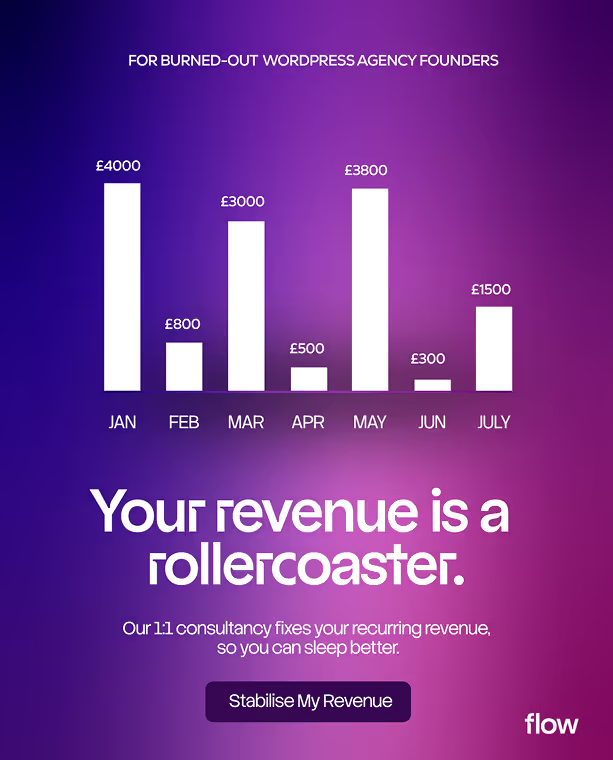
During: the visual hook. Every concept needs a central visual device that creates a pattern interrupt: an object, a mockup, an illustration doing the storytelling. Pure typography on a gradient is not a creative concept. It's a caption. Our internal rule is the Scroll Test: pattern interrupt (does it stop the thumb?), cognitive ease (is the idea graspable in under two seconds?), emotional trigger (does it make the right person feel something?). Fail any of the three and it doesn't ship.
After: iteration against data. First rounds of creative are hypotheses. The real service is watching what the account tells you (hook rates, hold rates, cost per qualified lead, not just CPL) and feeding it back into the next batch. Creative services without a performance feedback loop is just a design retainer with extra steps.
When you're evaluating anyone selling ad creative for B2B, this is the core question: are they selling you designs, or are they selling you the system?
The five ways to buy B2B ad creative in 2026
There are really only five models now. Each one is right for somebody.
1. In-house designer
Cost: £35–£55k/year salary (UK), plus tools, plus management time.
Best when you have enough volume to keep someone busy full-time and a marketing lead who can direct them. The catch: most in-house designers are brand designers, not direct-response designers. They'll make things beautiful; whether those things convert is a different skill, learned from watching hundreds of ads succeed and fail across accounts. One brand's worth of data is a slow teacher.
2. Freelancer
Cost: £250–£600/day, or £50–£150 per static ad.
Best for overflow and speed. The good ones are genuinely good. But you're buying hands, not the system. The strategy, angles, and iteration loop still have to come from you. And the reliable ones are booked out, which matters when Meta fatigues your creative in three weeks and you need the next batch yesterday.
3. Full-service agency
Cost: typically £1,500–£5,000+/month for B2B retainers that include creative alongside media management.
Best when you want the whole problem owned by one accountable team: strategy, creative, media buying, reporting. This is what we do at Sprint, so treat this as a biased opinion, but the honest case for it is that the feedback loop lives in one place. The people making your next batch of ads are the same people who watched the last batch perform. Nothing gets lost in a handover, and creative decisions are driven by account data, not taste.
The honest case against: if your ad spend is under ~£1k/month, a full retainer is probably premature. Fix that with option 4 or 5, or a project engagement first.
4. Creative subscription
Cost: typically £800–£3,000/month depending on volume and whether strategy is included.
The newest agency model: a flat monthly fee for an ongoing pipeline of ad creative (concepts, statics, variations) without the full media management retainer. It solves the exact gap most B2B teams have: you're happy running your own campaigns, but the creative well ran dry months ago.
The thing to check before you subscribe to anyone: is it a design subscription or a performance creative subscription? If the deliverable is "X designs per month" with no research into your ICP, no angle development, and no interest in how last month's batch performed, you've bought a vending machine. Volume without direction just gets you to creative fatigue faster.
(Yes, we're building one. It's the model we've effectively run inside client accounts for four years, productised. If you want in early, talk to us.)
5. Doing it yourself with AI
Cost: £0–£200/month in tool subscriptions, plus your time.
The genuinely new option. Between image models, ChatGPT-style research, and Canva's AI features, a founder or marketing lead can now produce ad creative that would have needed a designer two years ago. If you're pre-revenue or testing a channel with a few hundred pounds, this is honestly where you should start. It's how you learn what your market responds to without burning agency fees.
Here's the catch, and it's the same catch as the design subscription: AI is brilliant at producing and terrible at deciding. It will generate fifty variations in an afternoon, but it can't tell you which pain point to lead with, whether the concept passes the scroll test, or when the account data is telling you the angle is wrong. And because every model is trained on the same sea of existing ads, unguided AI output regresses to exactly the sameness the algorithm now punishes.
We'd know. AI is embedded in our own process, and we'll show you exactly where below. The difference isn't AI vs no AI. It's AI with direction vs AI without it.
What it should cost: the honest table

A useful sanity check whichever way you go: creative should generally be 10–20% of your monthly ad spend. Spending £5k/month on media with £0 on fresh creative is how accounts plateau. You're paying the platform to show people the same fatigued asset. Spending £2k on creative against £500 of media is the opposite failure; you'll never get enough data to learn which concepts work.
Eight questions that expose a weak provider
Ask these before signing anything. The answers tell you whether you're buying the system or the decoration:
1. "Walk me through how you'd find angles for our ICP." If the answer starts with your brand guidelines instead of your buyers' problems, walk away.
2. "What's your revision loop when an ad underperforms?" No answer = no feedback loop = design retainer.
3. "Show me B2B work and the numbers behind it." Pretty portfolio, no metrics? Decoration.
4. "What's your turnaround for a new batch?" Creative fatigue doesn't wait for a fortnightly status call.
5. "Will you tell us when our brief is wrong?" The right partner pushes back. The wrong one takes the brief and invoices.
6. "Who writes the copy?" In direct response, copy and visual are one unit. "You supply the copy" splits the concept in half.
7. "How do you use AI?" The wrong answers are "we don't" (they're slower and pricier than they need to be) and "it does everything" (you're buying the sameness problem). The right answer is specific about where AI helps and where humans decide.
8. "What don't you do?" Anyone claiming equal depth at TikTok B2C and LinkedIn B2B is average at both.
How we actually make ads at Sprint (AI included)
Most agencies treat their process like a trade secret, usually because there isn't one. Here's ours, start to finish, including exactly where AI sits in it.
Step 1: Research, AI-accelerated and human-grounded
Every engagement starts in two places at once. We use AI to do the wide sweep: mining reviews, forums, job ads and competitor messaging to map what your buyers are actually anxious about, in their own words. And we talk to you. Proper conversations about the business, your USP, and the customer pain points you hear on sales calls that never make it into the marketing.
The AI research gives us breadth in hours instead of weeks. The client conversations tell us which of those pain points actually closes deals. You need both. AI alone gives you a plausible-sounding average of your market; the conversations give you the specific.
Step 2: Go expansive, moodboard everything
Then we deliberately go macro before we go narrow. We moodboard loads of different visual territories: visual hooks, visual metaphors, objects and worlds that could carry the message. We get AI generating stacks of variations on each territory, and we use Pinterest to explore visual directions we wouldn't have found in ad libraries. If your reference points are only other B2B ads, you end up making other B2B ads.
This stage is intentionally messy. Fifty rough directions beat five safe ones, because the scroll-stopping concept is almost never the first idea. It's the one hiding behind it.
Step 3: Converge, pick the direction, write the copy
Now we get ruthless. We pick a direction, pull out our favourite visual hooks and concepts, and write the copy against them. Sometimes the copy idea leads and the visual follows; sometimes a visual metaphor is so strong the copy writes itself around it. There's no fixed order. What matters is that copy and visual are developed as one unit, not bolted together at the end.
Everything that survives this stage has passed the Scroll Test: pattern interrupt, cognitive ease, emotional trigger.
Step 4: Rebuild to our design standards
Here's the step that separates the system from the shortcut: nothing AI-generated ships as-is. We take everything from the exploration (the hooks, the references, the AI variations) and recreate the ad properly to our own design standards in Figma or Canva, applying our design frameworks and principles: one idea per ad, a central visual device doing the storytelling, typography and colour doing their jobs quietly underneath.
AI gets us to the right idea faster. The craft is still ours. That's the honest division of labour, and it's why the output doesn't look like everyone else's.
It's the system behind clients going from zero paid-social pipeline to booked sales calls, and behind accounts scaling monthly spend 5x while CPL fell. The case studies with the actual numbers are here.
If your ads are getting scrolled past and your current creative process is "brief the designer, hope", that's fixable, and it's usually fixable fast.
Book a call, or if you just want better creative thinking in your feed, we publish everything we learn on this blog.
FAQ
What are B2B ad creative services?
The research, concepting, design, copywriting and iteration behind paid social and display ads for B2B companies. Ideally run as a performance system tied to campaign data, not a one-off design deliverable.
How much do B2B ad creative services cost in the UK?
Freelancers run £250–600/day, creative subscriptions £800–3,000/month, and full-service agency retainers £1,500–5,000+/month. A good benchmark is 10–20% of monthly ad spend going to creative.
How often should B2B ad creative be refreshed?
Watch frequency and hook-rate decay rather than the calendar, but most B2B accounts spending £1–10k/month need new concepts every 4–8 weeks and fresh variations more often.
Do B2B ads really need professional creative?
Targeting is now largely automated by the platforms, so creative is the main variable you control. Accounts that treat creative as an afterthought plateau; accounts that iterate creative systematically keep scaling.
Can I just use AI to make my B2B ad creative?
For research, ideation and variations, absolutely. It's a sensible starting point on small budgets. But AI models are trained on existing ads, so unguided output converges on the generic look the platforms already punish. Use AI to explore widely, then apply human direction, copywriting and design standards before anything ships.


Lastest blog posts
Tool and strategies modern teams need to help their companies grow.

How Much Should a B2B Company Spend on Paid Ads? (UK Guide, 2026)
Forget generic benchmarks. Work backwards from the revenue you want, know your minimum viable test, and scale on one metric. The honest UK numbers for 2026.

B2B Ad Creative Services: What You're Actually Paying For (and What It Should Cost in 2026)
Most B2B companies buy "designs" when what they need is creative that converts. Here's what proper B2B ad creative services include, what they cost, and how to choose.


.svg)
The system that books qualified sales calls every week.